Let Outcomes Drive Your Data/AI Strategy

Drive business outcomes with an outcome-driven data strategy that transforms insights into actionable decisions

It’s not uncommon for an organization to strive to be more data-driven. What is less common is purposefully designing a data strategy around business outcomes for every role in the organization. Many invest heavily in dashboards, scorecards, and KPIs. While those tools create visibility, they often stop short of creating value. Said another way, these tools provide insights, but to become data-driven these insights must lead to action (actionable insights).

Case in point. A KPI may indicate your revenue is 5% below target. A scorecard may indicate your customer service needs improvement. Your leadership announces you need to increase your revenue and improve your customer service. While true, those insights are too broad to be truly actionable. They may convey a sense of urgency, but do not necessarily direct an employee’s next steps. To optimize the impact of the insights, focus on outcomes first, then on the data.

A properly-executed, outcome-driven strategy begins with optimizing the business activities that align with your desired outcomes. Once these activities have been identified, improve the execution of each activity by making them data-driven. Convert data into insights and insights into action. Let’s start by describing how to identify the activities.
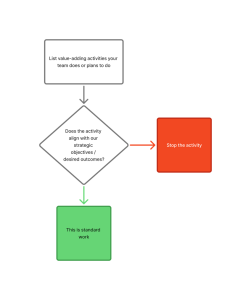
As you can see in the diagram above, value-adding activities that align with your strategic objectives/desired outcomes are considered standard work. These activities are worth documenting, adding to someone’s job requirements, and optimizing to achieve a competitive advantage. To optimize them, pass each of them through this optimization flow.
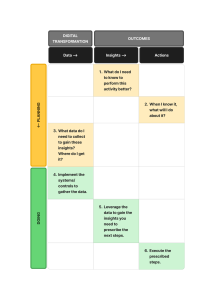
Too often, the planning begins with a focus on the data. When someone says “I have this data available. How can I use it to make data-driven decisions?” or “What is the best way for me to use AI?”, I respond by asking about their strategic objectives and what outcomes they hope to achieve. Before you can determine what data you need and how you will acquire it, you need to consider what you hope to achieve with it. If the data is not yet available or is not in a digital format, you may need to capture it via a new process, integration, or automation. That is why I often say Digital Transformation is a pre-requisite to your Data Strategy.

Let’s step through an example. During discovery for a predictive maintenance project, the maintenance manager asked us to start collecting telemetry from shop floor machines so he could use it to predict outages before they occur as part of his standard work. For an extrusion line that is about the distance of a football field, you can imagine the amount of data that could be collected from the various controls on the line. For some of the components, there was much data that was potentially irrelevant. For other components, some of the data we needed may be restricted by the equipment manufacturer or non-existent, so we had to discover creative ways to collect it. We started with the outcomes: identify the components that cause the most time and expense if they fail and start with them. A vacuum pump was the selected place to start because a two-week lead time is required if a replacement needs to be ordered, resulting in excessive downtime.

We stepped through the optimization process like this:

  1. What do we need to know? If the PSI of the vacuum pump is registering within its acceptable range.
  2. What action will we take? Inspect the pump to see if maintenance is required or a replacement is necessary.
  3. What data do we need and how will we get it?
    1. The current PSI reading on the pump every 15 seconds via a new IoT sensor.
    2. The upper and lower thresholds as stated in the engineering specs and quality historian data.
  4. Attach a sensor to the pump along with custom software on a Raspberry Pi to collect PSI every 15 seconds and upload it to a datastore.
  5. If the PSI is outside the acceptable range for a pre-determined period, send an alert to the Computerized Maintenance Management System (CMMS) to notify the technician on call.
  6. Technician diagnoses pump to see if maintenance is required or a replacement pump is necessary.

As you cycle through the optimization process for each standard work activity or workflow, that is the natural time to evaluate whether AI can help. Stepping through our AI Decision Tree (attached) for each activity will help determine if its optimal performance can be achieved through run-of-the-mill automation, AI, or neither. For example, consider the Accounts Payable process depicted below in our Automation Maturity Model.
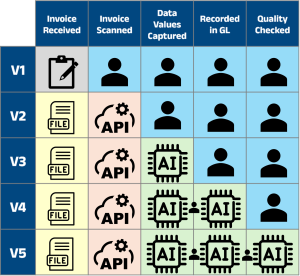

For Version 1 of the Accounts Payable process, receiving and manually scanning invoices were the largest bottlenecks. After automating that process via an API, capturing data off the invoice became the biggest bottleneck. With each version of the process, more automation and AI was added to eliminate bottlenecks. Where AI was utilized, sometimes a Human-in-the-Loop (HITL) approach was utilized to reduce risk and ensure quality.

Would you like to run through the process end-to-end with a trusted advisor? From identifying your outcome-driven standard work for a role to optimizing the work via automation and/or AI, we can assist with the planning and execution. Reach out to your Select Account Manager to schedule a time to meet.

Rob Wilson (3)
Rob Wilson
Principal Consultant

Share:

Join Our Mailing List

More Posts